Taiwan Reverses Brain Drain with Global Tech Investment
“The government provided support where needed, universities innovated their curricula in line with technological advancements, and companies grew. Through this, Taiwan’s ‘brain drain’ issue has been significantly resolved.”
John Kao, President of National Tsing Hua University, who recently visited South Korea to participate in the ‘Asia-Pacific Higher Education Summit’ hosted by QS, a British university evaluation agency, at Korea University, said in an interview with this newspaper on the 5th, “In the past, Taiwan’s universities also faced serious issues with top researchers leaving for Singapore or the United States due to poor treatment,” adding, “However, thanks to the government and companies stepping up and universities continuing to innovate, global tech companies are now entering Taiwan to build research centers and hiring Taiwanese students in large numbers.”

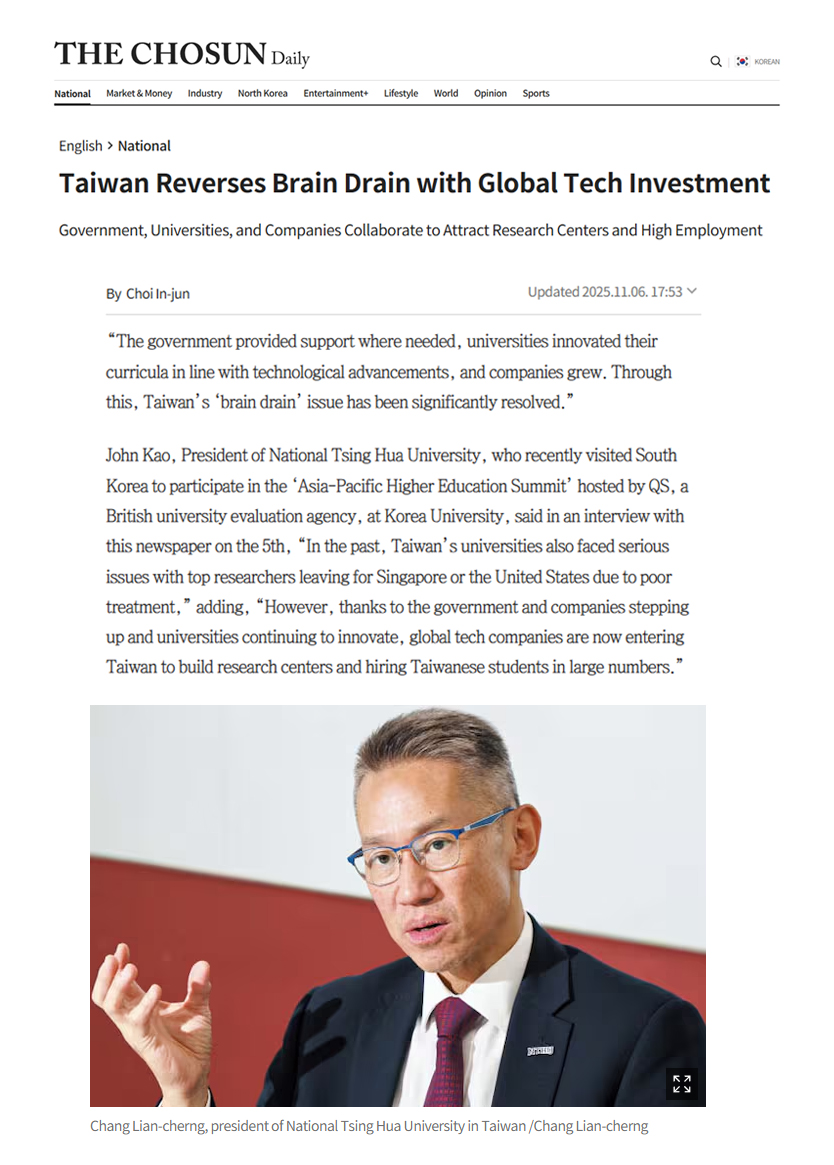
Chang Lian-cherng, president of National Tsing Hua University in Taiwan /Chang Lian-cherng
National Tsing Hua University supplies production and research personnel to Taiwanese semiconductor companies, including TSMC, the world’s top foundry (semiconductor contract manufacturing) company, MediaTek, and UMC. President Kao said, “The graduate employment rate is nearly 99%, and a school survey found that seven out of ten students prefer working at Taiwanese companies or universities rather than going abroad, showing a strong tendency to stay domestically.” The following is a Q&A with President Kao.
-How has Taiwan overcome the ‘brain drain’ issue?
“We have advanced research infrastructure and cooperative companies, and now we are focusing on raising professor salaries. Last year, we pooled donations from alumni and companies of National Tsing Hua University, along with government subsidies, to establish an ‘Outstanding Talent Development Fund’ worth 1.1 billion New Taiwan dollars (approximately 50 billion Korean won). We began paying performance bonuses to hundreds of professors using this fund. Some professors can receive up to 5 million New Taiwan dollars (approximately 230 million Korean won) annually per person.”
-Korean university professors find it difficult to receive high rewards even with good performance.
“Taiwanese universities also operate a seniority-based pay system, making it difficult to suddenly raise professor salaries. That’s why we decided to provide performance bonuses. To address dissatisfaction among professors who didn’t receive bonuses, we focused heavily on establishing objective evaluation criteria by academic field.”
-What role did companies play in preventing brain drain?
“In 2022, five major universities, including National Tsing Hua University, established semiconductor graduate schools. During this process, TSMC donated 4 billion New Taiwan dollars (approximately 187 billion Korean won). In the case of National Tsing Hua University, a high-ranking executive from TSMC who developed core technologies serves as the dean. Students trained here are active in Taiwanese companies and later return to the university to nurture the next generation, creating a ‘virtuous cycle’ that strengthens the technological foundation.”
-What other efforts are being made to retain talent?
“For professors and researchers, various conditions are as important as high salaries. National Tsing Hua University recently opened a daycare center on campus to attract young overseas professors. To secure talent, we must try anything first.”
-With good employment in companies, fewer Taiwanese students are pursuing doctoral degrees.
“This is the most concerning part. Advanced technology and corporate growth depend on cultivating doctoral-level talent. We are focusing on preparing countermeasures, as companies could face a talent recruitment crisis 5–10 years later.”